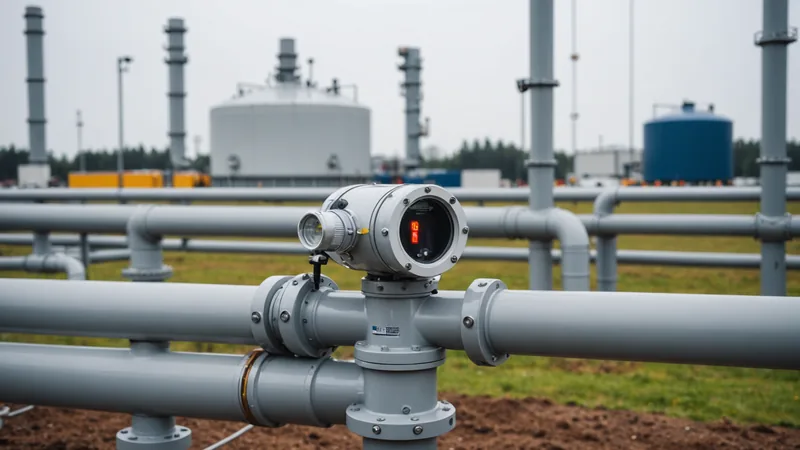
Detecting a methane leak is the first step in a chain that needs to end with a repaired fitting. In practice, the chain between detection and repair has more gaps than most operators realize. A sensor alert gets generated, it goes to an inbox, it waits to be triaged, it eventually produces a field crew dispatch, the crew arrives at the site without the right parts, and the repair gets delayed another 48 hours. By the time the fitting is actually sealed, the leak that was detected on Monday is still emitting on Thursday. The detection technology did its job. The workflow did not.
Where the Loop Breaks
The hand-off from sensor alert to work order is where most of the operational value of continuous monitoring either gets captured or lost. There are three common failure modes.
The first is alert fatigue. Systems that are not tuned to the site's baseline conditions generate high false-positive rates, and field crews learn to treat alerts as noise. When a real event produces an alert, it goes into the same queue as the previous dozen alerts that turned out to be background concentration variation, and its urgency is discounted accordingly. Getting the alert threshold calibration right for each site is not a one-time setup step. It requires iteration against observed baseline conditions over weeks, and most continuous monitoring deployments do not invest enough time in this calibration phase.
The second failure mode is attribution ambiguity. The sensor says there is elevated methane concentration in the northwest quadrant of the site. That covers 14 valves, two compressor connections, and an instrument gas header. The field technician arrives with no information about which specific component to inspect first, walks the area, does not find an obvious leak on a quick visual, and closes the alert as inconclusive. The leak continues. This is the detection-without-attribution problem: the sensor told you there was a leak, but not where the leak was, and the field crew could not find it without a more precise location.
The third failure mode is the work order backlog. Maintenance management systems at operating facilities process work orders through a priority queue. A sensor-triggered alert generates a work order that enters the queue at a priority level set by whoever configured the integration, which may or may not reflect the regulatory urgency of a detected emission event. In a busy maintenance period, a medium-priority work order might sit for two weeks before it gets scheduled. For a leak that started the day before the alert, that is now more than two weeks of unrepaired emission under OOOOb's repair timeline requirements.
The Source Attribution Requirement
The attribution ambiguity problem is solvable, but it requires both sensor placement strategy and signal processing approach. A single sensor placed at the downwind edge of a compressor pad can tell you that methane is present and at what concentration, but it cannot tell you which of the 30-plus components upwind of it is the source. That requires either a sensor array with enough nodes to provide directional concentration gradient information, or post-processing of multi-sensor data using atmospheric dispersion modeling to back-calculate the most likely source location.
When source attribution works well, the alert that goes to the work order system contains not just "elevated methane detected at CS-14" but "probable source: northwest compressor bay, most likely component within 8-meter radius of Rod Unit 2A based on multi-sensor cross-correlation, confidence level medium, recommend starting inspection at unit 2A packing and adjacent instrument connections." That is an actionable field dispatch, not an ambiguous location reference.
We are direct about the accuracy here: source attribution from sensor arrays involves modeling assumptions, and the "8-meter radius" figure is an estimate, not a surveyed measurement. The real-world accuracy depends on wind conditions, site geometry, and the number of contributing sensors. Under good atmospheric conditions with stable wind direction, attribution to within a few meters of the actual source is achievable. Under variable wind or in tight spaces with turbulent flow, the uncertainty is larger. The goal is to reduce the search radius for the field crew from "quadrant" to "specific equipment bay," which changes the field response from a 30-minute walk-down to a 5-minute targeted inspection.
Work Order Integration Architecture
The technical connection between monitoring platform and maintenance management system can be implemented in several ways, and the choice matters for how smoothly the loop closes. The simplest integration is email-triggered: an alert generates a formatted email to the maintenance dispatch inbox, someone reads it, creates a manual work order, and assigns it. This works, but it introduces a human hand-off that has latency and depends on someone being available to process the email promptly.
The more reliable integration uses a REST API or webhook connection between the monitoring platform and the work order system. When an alert passes the threshold and attribution criteria, the integration creates the work order automatically with pre-populated fields: asset ID, component area, alert description, priority level, and required documentation for completion. The work order appears in the maintenance queue without any human hand-off step.
The priority assignment in automated work orders needs to be calibrated against the regulatory timeline. Under OOOOb, detected leaks typically require repair attempt within 30 days and verified repair within 60 days. A work order that arrives in the maintenance queue as a standard priority item may not get attention within that window during high-activity periods. The automated work order should carry a priority level that reflects the regulatory deadline, with escalation if the work order ages without assignment.
Closing the Verification Loop
A repair that is completed but not verified is a documented intent, not a documented outcome. The OOOOb framework requires verified repair, which means re-monitoring after the repair to confirm that the leak has been resolved. For a periodic OGI program, verified repair means scheduling a follow-up survey visit, which may be days or weeks after the repair work is done.
With continuous monitoring in place, verified repair happens differently. The monitoring system is running continuously, so if the repair is successful, the concentration returns to baseline at the sensor locations within hours of the crew completing the work. If the repair did not fully seal the fitting, the elevated signal persists and the system can generate a second alert automatically, triggering a re-inspection without any manual follow-up scheduling.
This close-the-loop behavior is one of the highest-value aspects of continuous monitoring that is least often highlighted in the sales conversation about detection sensitivity. Finding the leak is the beginning. Confirming that the repair worked, without scheduling a separate monitoring visit weeks later, is where the operational workflow actually improves in a way that operators feel.
What Good Looks Like in Practice
The workflow that performs best in practice combines three things: alert thresholds tuned to site-specific baselines, source attribution confident enough to give the field crew a specific starting point, and work order integration that carries regulatory priority context automatically. When all three are in place, the time from sensor alert to verified repair can be measured in days rather than weeks. When any one of the three is missing, the loop develops the gaps we described above, and detection latency savings from continuous monitoring get eaten up by response latency in the dispatch workflow.
The measurement that matters is not "did we detect this event" but "how many days elapsed between event onset and verified repair." That is the metric that corresponds to actual emission volume and actual regulatory exposure. We track it at each site we monitor because it tells us whether the whole workflow is functioning, not just whether the sensors are working.
Source attribution estimates described in this article are based on multi-sensor cross-correlation methods and atmospheric modeling approaches used in our early-access deployments. Attribution accuracy is an estimate with site-specific uncertainty. It is not a substitute for direct component inspection and should be used as a guide to field crew starting point, not as a definitive source identification. Work order integration capabilities depend on site-specific maintenance management system configuration.