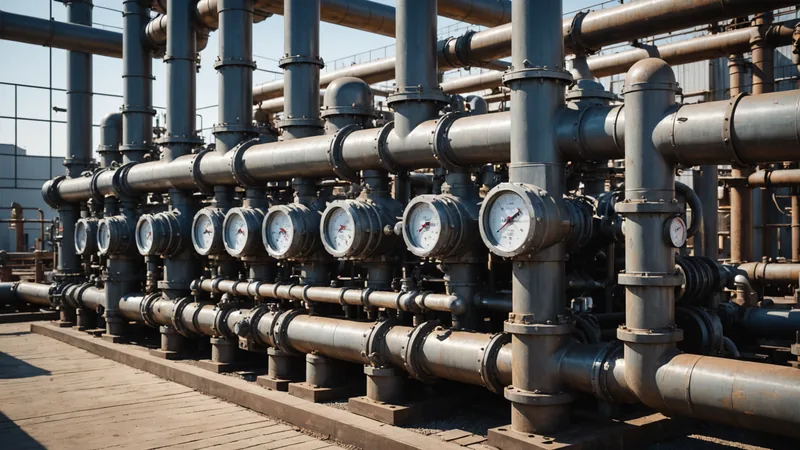
Compressor stations are among the highest-emitting source types in midstream natural gas infrastructure. They are also among the most regularly inspected. LDAR programs at gathering and transmission compressor stations typically involve more frequent monitoring than well pads because the equipment density and throughput volumes make the regulatory stakes higher. Despite this, compressor stations account for a disproportionate share of significant emission events in the field. The problem is not that operators are not monitoring. It is that scheduled surveys miss the categories of leaks that compressor stations generate most frequently.
Rod Packing on Reciprocating Compressors
Reciprocating compressor rod packing is the most common source of significant ongoing fugitive emissions at compression stations, and it is structurally ill-suited to detection by periodic walk-down surveys. Rod packing seals the gap between the piston rod and the compressor cylinder, preventing gas from escaping during the compression stroke. Packing degrades over the operating cycle, and the degradation rate accelerates under conditions of high differential pressure, elevated temperatures, and dirty gas with particulate content.
The characteristic pattern of rod packing leaks is not a sudden failure that would show up dramatically on any survey day. It is a gradual progression from tight-seal to weeping to slow continuous leak over a period that can span weeks to months. An OGI survey during the early phase of this progression may find nothing. A survey during the middle phase may find a detectable plume at moderate wind conditions. A survey during the late phase will find a visible leak, but by that point the component has been leaking for an extended period.
Continuous monitoring changes this picture not because it can detect smaller leaks than OGI, but because it sees every day of the progression rather than a single snapshot. An increasing trend in background methane concentration near a specific reciprocating unit, correlated across multiple sensors over days, is a different signal from a single-day reading above threshold. The trend is actionable before the leak becomes large enough to show clearly on a quarterly survey.
Centrifugal Compressor Wet Seal Vents
Centrifugal compressors with wet seal systems vent seal oil degassing to atmosphere or to a control device. When the seal oil circulation system is functioning correctly, the vent stream is primarily oil vapor with modest hydrocarbon content. When the circulation is degraded, circulation pump worn, or oil level outside specification, the vent stream can carry significantly more methane than design intent, and the regulatory limit for seal vent emissions is meaningfully lower than what a degraded system produces.
This is a blind spot for traditional LDAR because wet seal vent streams are often categorized as controlled emission points rather than fugitive emission sources. The control record may show that the vent is connected to a collection header, but if the header is operating at back-pressure or the routing valve is stuck, the effective control efficiency is not what the record assumes. An OGI survey may not identify this as a fugitive emission source at all, because the monitoring protocol may not include the seal vent as a component requiring survey coverage.
The resolution is component-level thinking in sensor placement. If sensors are positioned to capture concentration elevations near the seal vent area, degraded circulation conditions show up in the data before they appear in the component condition inspection log. Operators who have added this to their monitoring scope have found it to be one of the higher-value additions per dollar of monitoring investment at centrifugal compressor sites.
Instrument Gas Vents and Pneumatic Controllers
Natural gas-powered pneumatic controllers are a major emission source across all types of gas facilities, but they deserve particular attention at compressor stations because the density of pneumatic devices on a large compressor pad can be very high. A compressor station with dozens of actuated valves, dump valves, and level controllers, each venting a regulated volume of gas per actuation cycle, accumulates significant total vent emissions that are often categorized as continuous bleed rather than fugitive.
OOOOb and OOOOa both target high-bleed and intermittent-bleed pneumatic controllers, and the regulatory pathway for addressing them is either replacement with instrument air or low-emission pneumatics, or documentation of controlled emission rates. The blind spot in LDAR programs is not the controlled bleed from properly functioning devices. It is the over-venting from controllers that are stuck open, have worn internals, or have been field-adjusted to increase signal responsiveness at the cost of higher bleed rates. These malfunctioning devices look fine from the outside and pass visual inspection. Their elevated emission rate only becomes apparent if you are measuring actual vent flow against the rated specification or observing sustained concentration elevation near the instrument cabinet area.
Compressor Scrubber Connections and Sample Taps
Inlet scrubbers, glycol contactors, and dehydration units at compressor stations involve multiple flanged connections, sample taps, and level gauge connections that are subject to vibration from adjacent compressor operation. Vibration-induced loosening of connections is a recognized maintenance issue at compressor stations, but the connection between vibration exposure and LDAR frequency is not always reflected in the monitoring schedule. A flange connection that was tight during the last quarterly survey may have micro-loosened under vibration loading over the subsequent 60 days, producing a leak that will not be caught until the next survey.
Sample taps are a particularly common finding. When a technician opens a sample tap for a gas quality reading and does not replace the seal properly, or when a sample tap valve wears and develops internal leak-by, the result is a small but continuous vent that may be at exactly the wrong height and orientation for OGI detection during an outdoor survey in ambient wind conditions. These are not large emission events individually, but a station with 20 or 30 sample tap points can accumulate meaningful total emissions from multiple low-grade leaks that each individually fall below the OGI detection threshold in field conditions.
Flare and Blowdown Systems
Emergency blowdown connections and flare header piping at compressor stations are often excluded from routine LDAR survey scope on the reasoning that they are normally closed and would only emit during controlled blowdown events. The gap is valve condition: a manual blowdown valve that has developed seat wear may be leaking to the flare header continuously at low rates. If the flare header is not monitored with continuous instrumentation, this internal leak-by is invisible to both LDAR and process monitoring until the valve fails enough to be audible.
What Changes with Continuous Monitoring Coverage
The common thread through all of these blind spots is that they produce patterns, not events. Rod packing degradation produces a slowly rising signal. A stuck-open pneumatic controller produces a steady elevated baseline. A vibration-loosened flange produces an intermittent signal correlated with compressor load changes. These patterns are recognizable in continuous sensor data over days and weeks, but they are not reliably detectable by a snapshot survey that happens once every 90 days.
We are not claiming that continuous monitoring eliminates all blind spots at compressor stations. Sensor placement constraints, atmospheric conditions, and site geometry all affect what is detectable and at what threshold. The specific equipment categories described here have been among the more consistent findings in our early-access sites, but the specifics will vary. The operational principle is sound: monitoring programs designed around survey snapshots will structurally miss the category of emission sources that produce gradual trends rather than acute events.
The equipment categories and leak patterns described in this article are based on field observations from early-access deployments and publicly available technical literature on compressor station emission sources. Specific emission rates and detection outcomes at individual sites will vary based on equipment condition, operational parameters, and site configuration. This article is informational and does not constitute a compliance assessment or engineering recommendation.